Showing posts with label language learning. Show all posts

Thursday, January 29, 2015

Straining every nerve - American Accent Training

Heeey guys! :-)
I hope you're all doing well considering how many exams we're having this month. This is the very last week of this semester, guys, so let's keep up and get it over with.

Since the title of this blogpost is called "American Accent Training" you're probably expecting some of my strategies on how to improve my American pronunciation. If you want to know my general approach to a better pronunciation, feel free to read through my first blog post on pronunciation.

I must admit I am very late with this blogpost. The reason why is simply because I haven't found a third source on American Accent Training which I could recommend. I mean, there were many useful links which provided a handful of exercises and stuff, but none of them really got me hanging on. But after having tried out Rachel's and Amy Walker's English tutorials, I finally found a third source which I found worth sharing with you.

1. Rachel's English


Rachel clearly is a professional when it comes to (teaching) pronunciation. What I really like about her YouTube channel is that she has very specific topics, like "the TH Consonants" or "Contractions". She even has a few videos about Homophones.
As I mentioned in my first blog post about pronunciation, I really like doing Minimal Pairs, because it's not only a very effective but also a funny way to deal with pronunciation. And Rachel even has a playlist containing five videos about minimal pairs. I loooove these.
Another thing I like about her very professional videos is that the IPA sounds are displayed on the screen while she's pronouncing them. Also, the words she is talking about are displayed, so you can read them and repeat after her. The repeating is a very essential part of the pronunciation training. How are you going to improve your pronunciation without trying it out yourself? So that's why I like it a lot that she always pauses after a word so you can repeat it. Another advantage of such video tutorials is that you see how a native - in this case Rachel - moves her mouth. She (and Amy Walker as well) also explains which muscle movement is necessary for a certain sound. So far, I have benefited a loot from her tutorials.


2. Amy Walker


To be honest, I was a bit sceptical in the first place. Amy Walker seemed to me like a very friendly, but almost too friendly person. She smiles as if - well I don't know, but definitely too much, as it it was a fake smile. Anyways, I watched her tutorials since it is my goal to acquire an American accent. This is the link to her tutorials, by the way. Although I wasn't sure if she is the right person to teach me pronunciation (because of her exaggerated smile which I initally almost couldn't stand), I must say I really enjoyed it and I think she is doing a good job when explaining the differences between two siminar sounds. What I really like about her tutorials is that she provides a worksheet. I like having a sheet of paper right next to me so I can take notes if necessary. Her example words and sentences are really good, and there are many words which I use every day but have never really paid attention to their correct pronunciation.

She also has a video where she speaks 21 different accents. That's a really funny one, alhough I must say that the German accent is not 100% authentic. It's a good effort, though.


3. "Simple English Videos"


So the third source I want to share with you is different from the ones I was talking above. "Different" as in a bit unusual, but really funny. I like these kind of funny videos because if you find something amusing then it's more likely that you remember them.

 If I remember correctly, we watched one of the "Simple English Videos" in SUK I. I think it was this video we watched. But let me show you another one, of which you can see a screenshot on the right. He is American and the woman is British, and that's what makes their videos interesting. And yes, that's Rachel sitting inbetween the two.
What I like about their videos is that they provide a pronunciation, both an American and a British one. They do not explain the pronunciation in detail like Rachel or Amy would, but they tell you the meanings of a set of words which sound very similar or are even homophones. In the video you can see on the screenshot, they focus on the words fall, fell, fallen, feel and felt. They mention collocations and try to explain in a very humorous way what the words mean and how you use them. So, their videos are not telling you how to pronounce them according to the IPA - that's rather Rachel's and Amy's job - but they show you the differences between these similar words.
As I said, the videos are really amusing. And I think that's really important, because we as language learners study like crazy, and sometimes studying all day becomes really tedious. Am I right? But when watching the "Simple English Videos",  studying becomes definitely more funny, more interesting and more varied - at least for me. Give it a try, guys, it's brilliant!

- - -

That's it. I really hope you enjoyed the read. Two days to go and then we've finally mastered the 3rd semester. Since this is going to be the last post this semester, I'd like to say a few words about it.

I think we (English students) all agree that the 3rd semester was not exactly a walk in the park. We all struggled hard and did the best we could. And even though, our grades were not always the best. Teachers kept on telling us "you can do better" meaning that you should work harder. But what if I you simply can't do more because you have a second foreign laguage and you have seminaries and tutorials to attend. And yeah, there are about three papers to hand in by the end of semester; almost forgot to mention them. So sometimes a student just can't do more and simply needs a break. And here it is. So I think we can be proud of ourselves to have survived this constant struggle and we should enjoy the semester break to the fullest. So I wish everyone of you a relaxing and looong semester break. Have fun. Go crazy. Or do whatever you always do. And I'm looking forward already to seeing you next semester. ¡Adiós, amigos!

Tuesday, January 6, 2015

Sparing no effort to survive the Exam

Hey guys.
Welcome to my second blogpost on strategies how to improve my vocab and survive PC2. I've been reading a handful of blogposts of fellow classmates and I decided to try out a new dictionary. Also, I am going to tell you how I will master studying the words of the Porter book. So first of all: the new dictionary.

New Dictionary

The Collins Dictionary

So far, I have been using the dictionaries of Merriam Webster and Cambridge a lot as well as the vocabulary.com website. Now that I've tried out a few more online dictionaries, I'd like to share one with you that I found very helpful.
The Collins Dictionary allows you to decide whether you want to look up a word in a British or in an American dictionary. It provides a very short, but useful explanation of a word. I like this because sometimes, when a dictionary provides too many explanations, it gets even more complicated than it already is. Right next to the explanation, there are strong collocations provided, which also comes in very handy. If you are interested in the origins of the word, you can see those beneath the definitions. The Collins dictionary also shows synonyms and a direct link to the website's thesaurus. In addition to that, they offer translations in various languages. In some cases, it is helpful to not only look up a word in a monolingual, but also in a bilingual dictionary. Aaand what's the icing on the cake is that you can also see example sentences, very similar to the ones on vocabulary.com.
I highly recommend the Collins Dictionary as it has proven itself as very useful to me.


The two most important strategies how to study the Porter words

1. Repetition is the key

Vocabulary.com App

Using the vocabulary.com app was actually not a suggestion from a colleague, but from one of my English teachers. At first, I wasn't sure if I want to spend two euros on an application I will probably either not like or not use - or even both. I know that two euros is not a lot of money. But considering it is exactly the same like the website vocabulary.com, two euros are actually a lot. Why buying an app for my mobile phone while I can use the website for free?
In the end, I decided to download the app and just give it a try. And guess what. I LOVE IT <3
The app provides the exact same information squeezed on a mobile phone screen. I use it whenever I am on the bus, on the train or even when I am doing a shift as a paramedic, waiting for a call. I'm sure my colleagues think I am a total nerd studying vocabulary during a night shift. If only they knew that a lot of nights look the same in a Translation student's life. Sorry, I am going off on a tangent...
So about the disadvantages of this app. I'd like to mention two: First, the costs of course. Not everyone is willing to pay for an app since almost every app we use is free. And second, sometimes the speaker-button where you can listen to the word's pronunciation is not always working. But I don't know if this is the app's fault or it's just my crappy phone. Do you have any experiences with the app?

Anki App

When I first installed the Anki software on my laptop a few months ago, it didn't exactly work well. I think there was some kind of a bug so I couldn't use it properly. After reading through some blogposts of my student colleagues, I felt like installing and trying it again. They all said that it works perfectly and that they benefit from using it, so I downloaded the mobile app AnkiDroid Flashcards. And it worked! Woohooo. So that's how I became an Anki user. Why I benefit from using it?
I like that the app gives you the possibility to choose on your own what you want to put on the back of a flashcard. I am saying put because you can either write a definition, a translation, add an image or even an audio file. So you could add a voice note where you yourself pronounce the word - correctly of course.

What I do most of the time, however, is adding an English definition including synonyms and collocations. That's what helps me the most to learn a word. In rare cases, I also add a German translation.

Sooo, I recommend this app as well as the vocabulary.com app. The good thing about Anki is that it's free and you can either use the mobile app or the software.  In general, I'd say that using a mobile app to learn vocabulary is very practical. You can do it wherever and whenever you want: on the bus, on the train or, like I do, even during night shifts.


2. A spoonful at a time


Another important thing when it comes to mastering such a huge amount of words is to study the words in pieces - to somehow classify or cateogrize them. It's up to you how you like to classify them. I don't have a particular way of classifying them, but I study the Porter words unit per unit. Not bearing in mind how many words need to be learned in total helps a lot not to go bonkers. What is more is that it's a good feeling to complete a unit and be able to say that you've just learned a bundle of new words.

Also, I make use of the vocabulary sheets at the end of every unit. Not only do I highlight words I don't know, but also write them and their meaning down. I also add collocations and synonyms in order to remember the words more easily. On the second photo you can see the vocabulary sheet of the fourth unit. Let's take the word "sphere" as an example. I wrote "closed surface of round shape" and "area/sector/field" as short explanations and added "social sphere" as a collocation. Of course, this way of writing down vocab is not everyone's cup of tea. For me, however, it works quite well.

Thaat's it. I hope you enjoyed reading this blog post. You'll hear from me very soon as I still need to write a second post on pronunciation ;-) CU!

Monday, January 5, 2015

Summary of the Credit Crisis - Before and After

Helloo guys.

This blog post is going to be a bit different than my preceding ones. We, my fellow students and myself, were asked by one of our English teachers to blog about a summary we recently wrote. There is a first version of the summary and a corrected one. I marked the mistakes corrected by my teacher in different colors. I hope it doesn't look too confusing. If so, feel free to ask questions any time. Here we gooo.


First Version


The video The Crisis of Credit Visualized covers the origins of 2008’s credit crisis and its impact on the economy. The crisis is defined as a “worldwide financial fiasco” which caused the credit market to freeze in 2008.
A homeowner mortgages their house, i.e. they borrow money and pay back a monthly mortgage payment. This payment is received from investors who are seeking for investments where they can make more money. Investors borrow money in order to amplify potential gains. This is called leverage. The investor can choose between risky and safe mortgages. Safe mortgages have a low rate of return, while risky ones have a higher one.  This is called a collateralized debt obligation. In order to make safe mortgages even safer, banks insure the mortgages with a fee called the credit default swap.
When a homeowner defaults, the house comes into the lender’s possession. The lender then gives the house to less solvent people or sells it again. Putting more houses on sale creates more supply than demand. Consequently, housing prices fall. The investors invest in worthless houses and cannot pay back their loans. This leads to a frozen credit market where no one buys or sells anymore.
Author is missing
Not only does it cover its origins, but explains the crisis as a whole

It's not really a definition

Too wordy

Preposition

Wordy - use an adjective that describes "investments"

Wordy - there is a shorter way to say this

Wrong word

Delete

Focus a bit more on sub-prime mortgages

Tense


Corrected Version


The video The Crisis of Credit Visualized by Jonathan Jarvis explains the 2008’s credit crisis and its impact on the economy. The crisis is called a “worldwide financial fiasco” which caused the credit market to freeze in 2008.
When a house is mortgaged, its homeowner pays back a monthly mortgage payment. The investors receiving these payments can choose between mortgages of a lower or higher rate of return. This is called a collateralized debt obligation. In order to make low-return mortgages safer for investors, the mortgages are insured with a fee called the credit default swap.
When a homeowner defaults, the house comes into the lender’s possession. Normally, the lender sells it to another responsible homeowner. These are called prime mortgages. What occurred ahead of the credit crisis, however, was the divestment of mortgages to less solvent people, not requiring down payments or a proof of income. These are called sub-prime mortgages. If more sub-prime mortgages default, more houses are on sale. The abundant supply of houses causes their prices to fall. The investors invest in worthless houses and cannot pay back their loans, which they need to do to amplify potential gains. This lead to 2008’s frozen credit market.

Friday, December 26, 2014

How I improve my Pronunciation

Hey guys!
I hope you're having a fun and peaceful christmas break. I found some time to finally work on my pronunciation. I've learned that I have some problems with the th-sound, which is why I have been spending and will continue spending time on this topic. In addition to that, I devoted some time to minimal pairs. Let me explain to you in detail how I tackled these topics.

The Two TH Sounds

First of all, I had a look at Rachel's video about the two th sounds. She briefly explains the difference between the th-sounds which is very useful. The exercise at the end of the video didn't help me a lot as it's explained in a rather complicated way (that's what I think at least). So I searched for other sources on the internet and I stumbled upon this website: ESL Gold - Pronunciation - The Voiced TH sound. It provides a list of minimal pairs, challening words, common phrases and an oral reading exercise containing the voiced th sound. I recommend listening to the audio file and reading the words at the same time, because in my view it doesn't make a lot of sense to just listen to the audio without knowing how a word is spelled. For that I would open the audio file in a new tab so you can still see the list of words. BTW, the link to the audio file is on the top right corner, beneath the heading. It's a bit tricky because the link doesn't exactly catch one's eye.
What I like about this website is that the two speakers pause between the words and phrases. It makes it possible to repeat the word, although I must say you could also pause the video manually of course.
I must admit that I found these words quite challenging and that I never paid much attention to the difference between the voiced and unvoiced th sound. But this will be different from now on! ;-)


Minimal Pairs

One source I recently found and would definitely recommend is this website. You can find many many examples of minimal pairs and they even provide a short description of what is important about certain minimal pairs and what the main differences are between to miniml pairs.
What I like most about this website is that it is devided into the different sounds: vowel sounds, consonant sounds, initial consonant sounds and final consonant sounds. Also, the minimal pairs are categorized by elementary, pre-intermediate, intermediate, upper-intermediate and advanced words. I am familiar with most words and their pronunciation of the categories elementary and pre-intermediate, but some of the categories intermediate, upper-intermediate and advanced are really challenging.
Let me give you examples of the category advanced consontant sounds s - Īø.
Symbol - thimble
Sawn - thorn
Suds - thuds
Do you think these are difficult?


Practice, Practice, Practice

If you read my previous blog post about vocab learning strategies, you might have realized that I am a great fan of Merriam Webster's dictionaries. On their website, they provide interactive exercises. When doing such an exercise, you first listen to a couple of words and then repeat them. At the end of the exercise, you do a short quiz where you hear a word and must decide to which sound category it belongs to. You can do the quiz a second or a third time.
On the screenshot on the right you can see that I did an exercise on f and v sounds.

I find these exercises really useful. They provide a combination of listening to a word, reading and repeating a word. And there are so many exercises! I just love Merriam Webster! :-D


That's about it so far. Most of these websites do not provide videos where you can watch how natives move their mouth and tongue. But next time I will focus more on sources like this (e.g. Rachel's English). I'll also give you more general hints on how I tackle pronunciation. CU soon, guys!

Tuesday, October 28, 2014

How to go the extra mile

Long time no see, guys. Or shall I say "long time no read"? Welcome back to the 3rd round of Sophie's blogging. A good girl who one day went online and has been crazy about blogging ever since.
I hope your summer break was as fantastic as mine. I will tell you some details about my vacation soon. But for now, let's get back to business. I've spent some time thinking about ways how to efficiently expand my vocabulary. Here is what I came up with.

Books & Mind Maps

I like to work with books where I can highlight things and add comments. That is why I never just borrow books but buy them if they seem to be reliable sources. The Merriam-Webster’s Dictionary of Synonyms and Antonyms, for example, helps me to expand my vocab. and avoid always using words like "good", "bad" or "interesting". It not only provides me with synonyms and antonyms of a certain word, but also with an exact distinction between to words which are believed to be synonyms. Let me give you an example: According to the book, the verbs to devote and to dedicate are not exactly the same. To devote is likely to "imply a giving up [...] because of compelling motives" and to dedicate means "solemn [...] devotion to a sacred or serious use or purpose". So devote is more likely to be used with [to devote] one's free time/evening/etc to studying, whilst one would dedicate one's life to medical research, for instance.
Another Merriam-Webster’s book called Vocabulary Builder is very useful when it comes to learning an entire word family. The words are grouped by family, so for example benefit, beneficent, beneficiary, benevolence, benevolent and benefactor. By remembering the commong root bene, it is easier to memorize the words. At the end of every other unit, there's a short quiz so you can test yourself. As you can see on the picture, I like to create mind maps for those word families.

Another book I would like to mention is the Merriam-Webster’s Guide to Punctuation and Style. This book not only gives me hints and tips about punctuation, but copyediting, quotation, proofreading, word usage and many other topics as well. In spite of all the advantages of such books, and I am also including the Porter Book here, they all have one major drawback: They do not tell you how to pronounce a word. Therefore you need to have an online dictionary handy in order to listen to the correct pronunciation. If I am studying in the train, for instance, and I don't have a laptop with me, learning new vocabulary is almost impossible since I can't listen to the pronunciation properly. This can be quite tiring sometimes.

Online Platforms

When I am online I use online platforms like vocabulary.com or thesaurus.com. On vocabulary.com, in particular, I like to check the use of the word within a sentence. What I also like about the site is that I can create my own vocabulary lists and take vocabulary quizzes.

Even though I benefit a lot from these two websites, I still like to write down words in a small note book which I can take with me anywhere. Just going through a list on vocabulary.com is not enough for me to memorize a word. I always need to write it down by hand. Another website I would highly recommend is the Merriam-Webster's Visual Dictionary Online. Since I am more the visual type when it comes to studying vocabulary and I like to connect words with pictures or symbols, I use this website very often.


Corpora

So far, I haven't used various corpora often enough to be able tell which one is my absolute favorite one and which ones I don't like. One corpus I have used a few times, though, is just-the-word.com. This website has a simple and clear structure and the search results are listed in a very neat way. The user is shown a handful of collocations and how frequently a word or phrase occurs in that corpus. Another website I found very useful is the Oxford Learner’s Dictionary and its Academic Word List. This alphabetically ordered list is linked to the definitions of the words which comes in very handy.


Books and Newspapers

Whenever I read a book and I come across an unknown word, I try to remember it within its context. So for example, when reading one of my favorite books The Shadow of the Wind by Carlos Ruiz Zafón, I found this very interesting word "meekly". This is the sentence in which it occurs: "We could only nod meekly." To nod meekly means "to nod in a humble manner" (source: vocabulary.com). So I assume the person is being embarrassed or even humiliated at that moment. Or the person is simply being a very modest or humble person. Another example sentence of the word meekly is "[...] she was just meekly doing what mother told her to do" (source: Seattle Times). I am more likely to remember this word or the phrase "to nod meekly" because a) I found it in one of my favorite books, b) I remember it with its sentence and c) with the verb to nod.

Another one of my favorites is The Art of Thinking Clearly by Rolf Dobelli. The Swiss author analyses phenomenons of our daily lives which we aren't always aware of. Every once in a while I buy newspapers as they contain loads of vocabulary of a higher register.


Movies and Series

When I watch documentaries or series and I don't understand a word, then I simply guess the meaning of it. So first, I would write down the word, guess what it could mean from the context, and then I look it up in a monolingual dictionary. For example, as I am attending Henry Briscoe's lecture about the Culture of the U.K., I watch a documentary about Great Britain every now and then.
Of course, like almost every student, I watch series. My favorite one is "Pretty Little Liars", although there are currently no new episodes available. I also like watching Game of Thrones (even though I never thought I would ever like this series; I was forced to watch it and then all of a sudden I wanted to watch even more). Anyways... watching (American) series not only helps me a lot to expand my vocabulary, but also to practice my American English pronunciation.

---

This is already the corrected version of the blog post I handed in.
I hope you enjoyed the read. Stay tuned! :)

Sunday, June 1, 2014

Capitalization 101 - Part One

Since the writing parts of the Progress Checks have always been the ones I had to struggle most with, I am currently reading a lot about Punctuation and Style. Today, however, I'd like to talk about Capitalization and its abundant rules about beginning a sentence. I hope the following information and tips are helpful to you.

Beginnings

  1. Surprise, surprise: The first word of a sentence is capitalized.
    Example: Blogging is a great opportunity to practice writing.

  2. If a sentence is placed in parentheses, the first word of the sentence is capitalized.
    Example: Blogging is a great opportunity to practice writing. (There are a lot of other possibilities, of course.)

  3. If a sentence inside another sentence is in parentheses, the (inner) sentence is not capitalized.
    Example: Blogging is (among lots of other possibilities) a great opportunity to practice writing.

  4. The first word of a quotation is capitalized.
    Example: "Blogging is a great opportunity to practice writing," my teacher says.

  5. If a quotation is interrupted in the middle, the second part of the quotation is not capitalized.
    Example: "Blogging is a great opportunity to practice writing," my teacher says, "but there are loads of other possibilities."

  6. If a quotation is dependent on the sentence in which it appears, the quotation is not capitalized.
    Example: Blogging is "a great opportunity to practice writing."
    Or: My teacher said that "blogging is a great opportunity to practice writing."

  7. If a motto, rule or direct question, whether a quotation or not, appears in another sentence, it is capitalized.
    Example: The question is, How many blog posts do we need to have by the end of the semester?
    Or: You know the saying "Practice makes the master."

  8. The first word following a colon is usually lowercased when it begins a list or even a complete sentence. When the sentence, however, is longer and seperate from the preceding one, the first word is capitalized.
    Example: A good language learner practices these four language skills: reading, writing, listening and speaking.
    Or: A good language learner has the following characteristics: he is open-minded, communicative and eager to learn.
    But: One more thing: A good language learner must neither be idle nor biased, but curious about different countries and cultures.

  9. The first word in an outline heading begins with a capital.
    Example:
    1. Introduction
    2. Body Paragraph
      1. Thesis I
      2. Thesis II
      3. Thesis III
    3. Conclusion

  10. The first word and some particular words of a salutation of a letter are capitalized. As far as the complimentary close is concerned, the very first word begins with a capital.
    Example: Dear Sir or Madam; Ladies and Gentlemen
    Or: Sincerely yours; Truly yours
Source: Merriam-Webster's Guide to Punctuation and Style, Second Edition

Wednesday, April 23, 2014

Spanish in the United States

Spanish is the most spoken non-English language in the United States. Some 37.6 million Americans speak Spanish. Among these Spanish speakers, there are 34.8 million Hispanics while 2.8 million are non-Hispanics who still speak Spanish at home every day. The next most spoken non-English languages in the U.S. are Chinese, Hindi and French.

http://www.pewresearch.org/files/2013/08/FT_Non_English1.png

History

The Spaniards set foot in what is today the U.S. long before the English did. In 1565, they founded a colony in Florida which is nowadays considered as the first permament Spanish colony in North America.

Between 1803 and 1804, when Louisiana was sold to the U.S. (the Louisiana Purchase), its Spanish (and French) inhabitants became citizens of the States, but continued to speak their mother tongue.

In the Mexican-American War (1846-1848), Mexico lost almost half of their territory to the United States, including today's Texas, Colorado, Arizona, New Mexico, Wyoming, California, Nevada and Utah. The Mexicans, who were Spanish-speakers, became U.S. citizens. The constitutional convention of 1872 wanted the very little remaining Spanish-speakers to learn English and therefore published all official documents only in English.

In 1898, Cuba, Puerto Rico, the Philippines and Guam became American territories (Spanish-American War). A few years later, Cuba became independent again, while Puerto Rico remained a territory of the United States. Today, the most-spoken language of Puerto Rico is Spanish, although its inhabitants are U.S. citizens.

The number of Spanish immigrants to the United States has skyrocketed within the recent years. The Spanish-speakers have especially settled in California, Arizona, New Mexico, Texas and the southern part of Florida. During the Mexican Revolution from 1910 to 1917, a number of Mexicans flee to the U.S. Also Cubans immigrated to the U.S. due to Cuba's political instability around 1959. In the 1970s and 80s, lots of Spanish-speaking Nicaraguans moved to the U.S. because of the political instability of Nicaragua. Due to economic and political problems in El Salvador, a great number of Salvadorans relocated to the U.S. Also Venezuelans settled in the U.S. as they were hoping for a better education.


File:Spanish in the United States by countr.gif

American words derived from Spanish

  • Cafeteria (cafeterĆ­a; in Spanish there's an accent on the "i")
  • Chocolate (from Nahuatl xocoatl [Nahuatl = the most-spoken indigenous language of Mexico])
  • Guitar (guitarra)
  • Peninsula (same word in Spanish)
  • Bodega (a New Yorker would use this word to describe a corner store)
  • Canibal (Christopher Columbus came across an indigenous group called the Caribs (who gave the Caribbean its name). He pronounced their name wrongly by calling them caniba. Caniba became canĆ­bal in Spanish and cannibal in English.)
  • Cargo (derived fom the Spanish verb cargar which means to carry)
  • Cilantro (Americans might also call it coriander)
  • Ranch (derived from the Spanish word rancho)
  • Rodeo (same word in Spanish; derived from the verb rodear, meaning to encircle)
  • Florida (means land full of flowers in Spanish)
  • California (the word was first used to describe the North American territory in the 16th century)
  • Montana (a mispronunciation of montaƱa which means mountain in Spanish)
  • Nevada (means snow-capped peak in Spanish)
  • Alcatraz (is the Spanish name for a bird; in English known as the Northern Gannet)
  • Colorado (means colorful in Spanish)
  • And so on and so forth...

Spanglish

Spanglish is a mixture of Spanish and English and very common among Hispanics, especially in North- and Central America. Still, Spanglish is not considered an official language as it is used in spoken and informal conversations. There is a number of dialects which differ from one another.

A bilingual speaker can either switch between English and Spanish within a sentence (code switching) or create new words and idioms by adopting words into another language. wikipedia gives the following two examples:
  1. code switching: "I'm sorry I cannot attend next week's meeting porque tengo una obligación de negocios en Boston, pero espero que I'll be back for the meeting the week after" (I'm sorry I cannot attend next week's meeting because I have a business obligation in Boston, but I hope to be back for the meeting the week after).
  2. adaptation of words: the Spanish verb llamar (to call) becomes telefonear (telephone+ar) or almorzar (to eat lunch) becomes lunchear (lunch+ar). wikipedia gives other examples like: watchear, parquear, emailear, twittear, etc.


image source (1): http://www.pewresearch.org/files/2013/08/FT_Non_English1.png 
image source (2): http://upload.wikimedia.org/wikipedia/commons/thumb/2/29/Spanish_in_the_United_States_by_countr.gif/800px-Spanish_in_the_United_States_by_countr.gif 
image source (3): http://i.huffpost.com/gadgets/slideshows/322446/slide_322446_3046050_free.jpg
image source (4): http://i.huffpost.com/gadgets/slideshows/322446/slide_322446_3043041_free.jpg

Thursday, April 3, 2014

How to Place Someone in Recovery Position

Hey guys,

File:Recovery position.svg
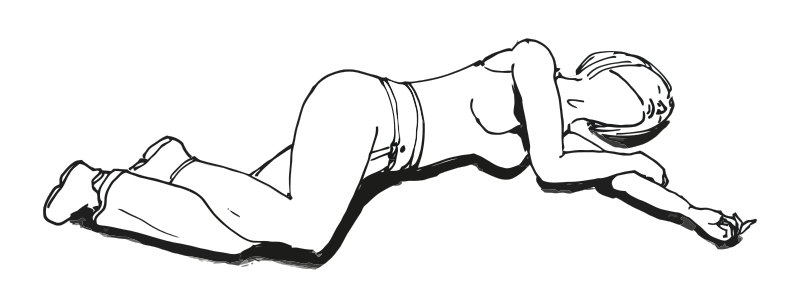
Are you making good progress with studying for PC1? I'm getting on well, but I'm definitely out of practice when it comes to giving advice and instructions. In order to do well on this part of PC1, I am now going to give you instructions how to place someone in recovery position. In case you're not familiar with that phrase at all, maybe the image on the right hand side will be a help. Doens't ring a bell? Maybe you'll remember while reading through the instructions.

image source: http://upload.wikimedia.org/wikipedia/commons/thumb/3/31/Recovery_position.svg/800px-Recovery_position.svg.png

--

Introduction

The recovery position is a basic first aid treatment that you've certainly come across in a first aid course. You might remember the recovery position as an easy practice. There are a couple of niceties though that I'd like to make you aware of.

Indication

A person that is unconscious must be placed in recovery position in order to avoid the person from suffocating. When someone becomes unconscious, their muscles are no longer able to let the person swallow. As a result, the person would swallow their own vomit in case he or she throws up. Additionally, someone can suffocate from the tongue falling back into the airway. Surely we don't want that to happen, which is why we place the person in recovery position.

First approach

The best thing to find out if a person is unconscious is to address the person by asking if everything is alright. In case the person doesn't answer, you can assume that he or she is either asleep, unconscious or, in the worst case, not breathing at all. In former times people used to lightly hurt someone by pinching their hand. Please note that this practice is no longer in use. Instead, it would be a good idea to grab the person's shoulder and simply shake it once or twice. If they are still not responding, call 144 (or 9-1-1 in the U.S.) or tell someone else to do so. Subsequently, knee down next to the person in case you haven't done that already. Before checking if the person's still breathing, you need to use a certain technique that is called the head-tilt chin-lift maneuver. The clue is in the name. To make use of this maneuver, place one hand on the person's forehead and your fingers of the other hand on the chin. Push the forehead down and lift up the chin. By doing so, you ensure that the patient's airway are not obstructed by their tongue falling back. Please remember that the head-tilt chin-lift maneuver can unly be used if you are a 100% sure that the patient does not have any neck injuries.
Come closer to the person's head in order to hear whether they are breathing or not. At the same time, look towards the person's stomach so as to make out any breathing movement. It would be adivsable to do that at least for 10 seconds. If there is no breathing at all, start with a CPR immediately. In case the person is still breathing, place him or her in recovery position.

The recovery position

Unless the patient has an obvious neck injury, he or she MUST be placed in recovery position. To do so, be sure the patient lies on the back. Place one arm 90° away from the body. Then, grasp the patient's second arm as well as the leg of the same half of the body. By holding arm and leg, gently turn the person onto the side where the other arm lies. If I were you I'd ask someone to grasp the patient's head and turn it to the same side and at the same pace you turn the patient's body. Make sure the leg you just moved is bent. We don't want the patient to roll onto the stomach, do we? Not only should you bend the leg, the arm you just turned to the side should be bent as well. Following that, use the head-tilt chin-lift maneuver one more time with the aim of letting the patient inhale and exhale properly. Additionally, you can place the hand that's lying on top under the patient's cheek. Consequently, the patient will be in an absolute stable position.

The best thing to do while waiting for the ambulance is to stay close to the patient. You might want to check the breathing every three or four minutes. In rare cases the patient's condition may deteriorate, which is why checking whether the patient's still breathing is a must. Generally speaking: Take care not to become anxious or even panicky. There's nothing that could go amiss, so try to stay calm and think clearly.

--

Any questions on that? Feel free to add a comment or ask me in person.

Sunday, March 16, 2014

Five ways to spice up your Blog

Howdy, language learners!

Today, I am going to give a few hints and tips how to make your blog (posts) even more intriguing to read. I hope you can take something personally for you from here.

1. Content

When deciding on a topic to write about in your blog, you should choose something you are really interested in. Your readers will notice if you're not really into a topic. For example, if I wrote about soccer, people would immediately see that I am neither interested in that kind of sport nor do I know the rules of it. Seriously, I really don't know the rules. Knowing that guys are running after a football is enough information for me, haha!

Long story short: Try to choose a topic that you love to talk, read and write about! If you write about a topic you like, people will like to read your thoughts about it.

2. Length of Blog Posts

At first, I would like to mention a helpful acronym: KISS. No, we're not talking about kissing here, guys. I am talking about

K - keep
I - it
S - short (and)
S - simple

Personally, I like to read blogs that keep their posts interesting, but simple. Going too much into detail might show that you really are into a certain topic. Your reader, however, is more likely to glance over or even stop reading your text if you get lost in details. That's why you should keep your posts "short and simple". Mention everything that's necessary for the reader to understand what you're trying to say. This can be difficult sometimes, I know. But hey, we're all learners here, so let's give it our best shot!

3. Style and Register of Writing

The reader of your blog should see that you are talking to them. I'm, for example, always trying to say "you" instead of "one": "you shoud", "you could", etc. What's more is that asking questions will get your reader's attention and they are more likely to keep reading: "Have you ever tried these?", "Have you ever been to Barcelona?", "Have you ever heard of this website?" etc.

When we talk about register, it's absolutely important to adapt the register to the situation and the person you are talking to. I.e. when you are talking to your boss at work, you will use a rather formal register. Instead, when talking to a friend, you would use an informal way of speaking. Therefore, a neutral register would be appropriate in terms of blogging.

4. Add photos

"A picture is worth a thousand words." Of course, we should focus on writing here and not on adding nicely photoshopped pieces. Pictures are a crucial part of a blog post, though. When adding a photo or infographic to your blog post, people are more likely to read through your texts. It is a natural habit of human beings to concern oneself with a text when there are pictures included. Let's be honest, none of us is fond of reading a 600-page book without a single picture in it. That's just tedious. Pictures jazz up your blog posts, so try to add at least one or two! But: Don't overdo it!

5. Template

Try to find an eye-catching template that makes your blog special. Keep it simple though, your template should offer a clear view. What's more is that you shouldn't use kitschy or neon colors. I guess your readers won't be that grateful for suffering from an eyestrain after looking at your blog. Along with the proper choice of colors, try to use a font that is easily legible. You should know that serif fonts are only used for printed papers. Sans serif fonts, however, are used for texts written for e.g. the world wide web. It's easier for our eyes to read sans serif fonts on a screen.

--

And now, it's my turn...

to tell you what I would like to improve about my blogging habits. Firstly, I would like to write a lot more and about different topics. My preceding blog posts dealt with my favourite TV-series, places I've been to, my job within the Red Cross and all that jazz. That's all well and good, but as I said, I'd like to tackle some other subject matters in this semester. Secondly, I tend to just list some points about a certain topic instead of writing a paragraph. Writing a paragraph is more beneficial when learning a language, I believe. I need to practice paragraph writing for our progess checks anyway.

All in all, I will try to spend more time on blogging, write about diverse topics and focus on writing paragraphs instead of just listing some words or phrases.

Saturday, January 11, 2014

Talking about Register

Before I came to study TKK at the University of Graz, I had never really paid attention to register. Now that I am an English student, register became an essential issue, especially when you're not writing to friends or relatives.

Firstly, I want to briefly talk about the three different types of register. Afterwards I'll show you what kind of register I've came across in lyrics.

1. Formal register

The register you use always depends on the social setting, the people you are talking to and why. It goes without saying that register also depends on your age and dialect. The formal register is used when talking to business partners or people of a higher status.

When it comes to linking words or sentence adverbials that you use in a writing, you need to be very careful with the appropriate usage of these words. For instance, the words hitherto, by contrast, conversely, nevertheless, nonetheless, accordingly, with reference to, hence, etc. are of a high register. On the contrary, adverbials like Mind you, So, And, I mean, That reminds me, Anyway, Anyhow, By the way, etc. wouldn't be used in a formal register, but rather in spoken English.

2. Informal register

The informal register is very common in spoken English and if you are texting people who are close to you. For example, when I am writing to my Irish friend David, I would start like this: Hey David, how you doing? I would never use these words when writing to my former working colleagues in Zurich, Switzerland or when writing a business letter.

3. Neutral register

The neutral register is, as can be assumed, kind of a middle course between the informal and the formal register. It's generally used when talking to people you don't know very well and still want to be polite with.

There are numerous sentence adverbials of a neutral register and can therefore be used in either a formal or an informal conversation. For example: beforehand, eventually, lastly, subsequently, on the one hand, on the other hand, despite, though, regarding, as a result, and so on and so forth ...
--

Let's have a look at the the song Royals by Lorde now. I'm aware that the register of this song is on purpose. The reason why I am searching for informal words and suggest formal ones is because I want to practice it!

For some words and phrases I have found a synonym of a higher register. I've underlined these words in the lyrics and explained them afterwards.
[Verse 1]
I've never seen a diamond in the flesh
I cut my teeth on wedding rings in the movies
And I'm not proud of my address,
In a torn-up town, no postcode envy


But every song's like gold teeth, grey goose, trippin' in the bathroom
Blood stains, ball gowns, trashin' the hotel room,
We don't care, we're driving Cadillacs in our dreams.
But everybody's like Cristal, Maybach, diamonds on your timepiece.
Jet planes, islands, tigers on a gold leash.
We don't care, we aren't caught up in your love affair.


And we'll never be royals (royals).
It don't run in our blood,
That kind of luxe just ain't for us.
We crave a different kind of buzz.
Let me be your ruler (ruler),
You can call me queen Bee
And baby I'll rule, I'll rule, I'll rule, I'll rule.
Let me live that fantasy.


[Verse 2]
My friends and I—we've cracked the code.
We count our dollars on the train to the party.
And everyone who knows us knows that we're fine with this,
We didn't come from money.


[...]


Words and phrases that are rather informal

  • Several times, contractions appear in the writing such as I've, I'll, we've, etc.
  • In the second paragraph, it says trippin' instead of tripping.
  • The phrase to not care is quite rough, I think it would be nicer to say to not bother.
  • Kind of wouldn't be used in a formal writing, but in spoken language (I guess..)
  • The word luxe is normally followed by a noun, but here it isn't.
  • To crave sounds also fairly informal to me; I believe that to desire sounds better.
  • The word buzz I am not sure about. It doesn't sound formal to me. I guess it depends on the context you're using it. Here, however, the word fits.
  • In the first line of verse two, the phrase to crack the code sounds rather informal. Instead we could say to decode.
  • The phrase to come from money in the very last line is not of a high register, at least that's what I assume as it can't be found in a dictionary.
  • In general, the lyrics don't consist of any (or very little) formal words that derive from Latin or French
  • ...

I came up with very little informal words or phrases in these lyrics. This was the first time I took a closer look at lyrics. I will, however, look at some other lyrics every now and then to increase my lexicon and to have a look at the song's register.

For those of you who are now in the mood to listen to this song, here is the link to the YouTube video:


Monday, October 28, 2013

Studying English - the usage of dictionaries

Since I just started to study English (and Spanish) at the University of Graz, I’ve been keeping myself busy with trying out a variety of online dictionaries. These are the ones I find most useful:

Vocabulary.com as a monolingual dictionary. It has a clear overview and simple and understandable definitions. Besides, by signing up for vocabulary.com, you can easily safe words and phrases in a list and revise them every once in a while.
www.vocabulary.com


Pons.eu as a bilingual dictionary. I even installed the PONS-Software which was included in the hardcover edition of the PONS dictionary. The picture on the left handside shows how the software looks like. Highly recommend it.
www.pons.eu


Thesaurus.com, which can be used for looking up synonyms and antonyms of words and phrases. Very useful.
www.thesaurus.com